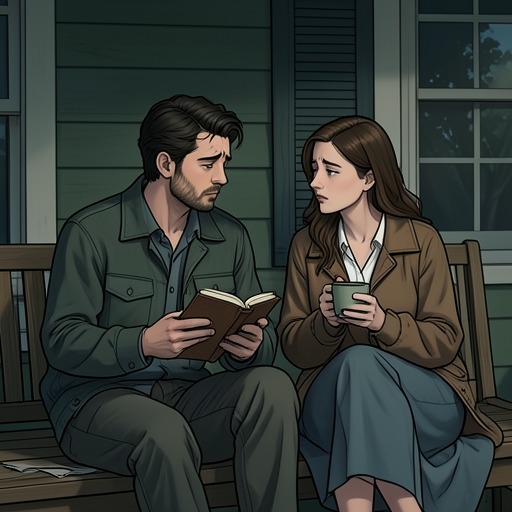
Hig–Melissa relationship
The Dog StarsHig–Melissa relationship is a marriage remembered in the aftermath of the pandemic, which killed Melissa and left Hig grieving both her and the child she was carrying. The relationship appears less through scenes of their shared life than through what Hig still expects, imagines, and cannot return to: a family and a home that no longer exist. His memories of Melissa’s absence run alongside grief for the natural world, making private bereavement and environmental loss inseparable parts of his experience of the end of the old life.
Marriage and Loss
Melissa is Hig’s wife, and her death belongs to the devastation that followed the pandemic. Hig also imagines their unborn child as part of the family he has lost. In a moment of apparent normality, he pictures Melissa alive and seven months pregnant, back on the Front Range while he returns from a flight. The scene makes the distance between imagined domestic life and his actual circumstances stark: the flight has taken nine years, and there is no genuine return to the world in which his wife and child could be waiting.
Hig’s recurring grief is not presented as a settled recollection. The imagined homecoming briefly restores an ordinary future, then exposes its impossibility. The marriage matters in the narrative as an enduring attachment against which the present is measured: the old airport procedures and the prospect of landing bring back not only a former routine but the family Hig wishes were still there.
Ecological Grief and Memory
Hig’s mourning for Melissa exists beside his grief for vanished wildlife, especially the trout he once loved to fish. He remembers the loss of brook, rainbow, brown, cutthroat, and cutbow trout, and associates their disappearance with the last fish swimming upriver in search of cooler water. The scale of that loss is repeated in his fear that even carp may disappear. These are distinct losses, but the narration places them in the same emotional register: Hig’s grief reaches beyond his dead family to the living world that has also been diminished.
The changed climate gives that grief a continuing cause. By mid-April, familiar seasonal expectations have become nostalgia; after two winters in which the mountain peaks held almost no snow, Hig fears ecological change more than attacks or disease. He worries that losing the creek would be worse than losing the trout. Fishing in surviving or recovering woods preserves a connection to places that still hold running water and living trees, while also recalling a past when more things were alive. The practice does not restore what is gone; it gives Hig a way to remain attentive to what survives.
Home and the Limits of Return
Hig’s imagined reunion with Melissa is set against the actual return that eventually brings him back to Erie. As he approaches, the eight miles of prairie and the perimeter he shared with Bangley become the threshold of home. Seeing the tower they built together, Hig realizes that Bangley has become his family. That recognition does not erase Melissa or replace the marriage; it marks a changed belonging formed after the loss of his original family.
The contrast defines the relationship’s lasting significance. Melissa and the unborn child remain central to Hig’s memory of the life destroyed by the pandemic, while the home he can reach is now a fragile survival partnership. His return to Erie cannot undo the nine-year separation or recover the family he imagines. Instead, the narrative holds both truths together: Hig continues to orient himself toward the lost marriage, even as his understanding of family changes around the people who remain.